
 AFA Advisory Group - Concern #1 - Building Concensus of Opinion
AFA Advisory Group - Concern #1 - Building Concensus of Opinion
AFA Advisory Group - Concern #1 - Building Concensus of Opinion
|
January 14, 2007
The January 8th-9th meeting's consensus-building process was vastly improved over the previous months. The KBM Forestry Consultants' facilitators had taken a step back and decided to change their methodology. As a result, quite a bit of progress was made in laying down "values" and "objectives". Dave Thomson was KBM's primary facilitator, elicitting input and commentary from group members. He effectively promoted discussion of many issues, causing a number of differing perspectives to be openly shared. Development of consensus of opinion was aided as much by Dave's efforts toward discussion, as it was by the method of recording members' inputs into an on-screen "Powerpoint" active file. As an improved modern version of the traditional "flip-chart", it was an efficient way of compiling, organizing, refining and revisiting the members' "values" and "objectives". The Powerpoint file will serve as the base for the February meeting at which we'll be getting into associated "targets" and "indicators". December 26, 2006 On December 5th, a revision of the Forest Certification Advisory Group Terms of Reference (based on input from the November meeting) was emailed out to advisory group members. It's section pertaining to Decision Making Methods included substantial modifications and clarifications, both in the areas of consensus building and dissenting opinions. On December 20th another email was sent out from the AFA to all advisory group members. In it, Gord Cumming stated that there would be some changes to the agenda and format of the next meeting. He indicated that at the next meeting the terms of reference would be finalized establishing the consensus based approach as the format for all future meetings and that Dave Thomson will give a presentation on participatory decision making and will facilitate all future meetings. Gord also indicated that the focus of the January meeting will be to discuss and identify values for the Algonquin Park Forest. The email's accompanying agenda for the January meeting provides for extensive discussion of the question “What does Algonquin Park mean to you and what values are important to you and/or the group you represent?" and for subsequent defining of these values' objectives, indicators and targets (V.O.I.T.'s). From these developments, it appears that the AFA and its consultants will be facilitating the consensus-building process in a more open and participatory direction. This change appears to be in response to concerns expressed by a number of the advisory group, myself included. I'm optimistic that future meetings' consensus-building will be more "member-driven".
November 23, 2006 In the Terms of Reference, it is stated that concensus of opinion is to be saught by four rather passive steps, afterwhich it is to be determined if progress toward a concensus is occurring by way of periodic voting. 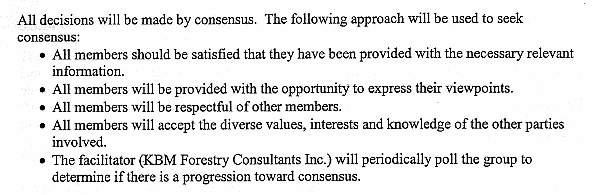
This process was practiced at the November meeting. While some technical issues were being argued between opposing forestry and environmental professionals, it occurred to me that some of the others present (myself included) were not getting an easy grasp of these issues. A particular discussion/argument concerning "Old Growth Management" had been going on for quite a while without any discernable progress. In the absence of either "clarity" in the process or any effort to introduce "clarifications" by the facilitator, I was forced to comment that I sensed the two "sides" were using the same term to label two different things and were then discussing "it" from two distinctly different perspectives. When the two different definitions were made clear, the discussion's ambiguities and cross-purposes became clear. A few days later another professional communications facilitator informed me that a commonly used and productive way to build concensus is to have participants express their individual understandings of and positions on an issue and to record them on a "flip-chart" .. showing the number of various understandings and the adherants to each understanding, as well as individual positions toward each understanding. I wish that this method of "concensus-building" had been employed at the November meeting. I believe the time spent would have better informed the less-professionally knowledgeable amongst us, would have given clarity to the group's communications and would have produced a stronger concensus of opinion on issues being discussed. |