
 Algonquin Park Forestry - Introduction
Algonquin Park Forestry - Introduction
Algonquin Park Forestry - Introduction|
Having recently accepted an invitation to serve, as a representative of recreational users' interests, on the forest certification advisory group for the Algonquin Forestry Authority's application for CSA certification, Ive created this new "Forestry" section of the website. This section is organized in two areas. The upper part of the side menu takes one to pages providing insight to the recent developments in both park management and sustainable forest management (SFM), and in the SFM certification process (at both global and national levels). The lower part of the side menu takes one to pages with information specific to my participation in the AFA CSA advisory group. I've always been interested in the means by which the MNR manages the park and the AFA manages its operations. Over the years, I've attended open houses and communicated with both organizations' senior staff. However, this is my first opportunity to serve in an official advisory capacity. While it is my position that limited and properly managed logging has a valid place in the life of Algonquin, I also believe that there should be responsible and continually improved care of our natural heritage. Within the framework of forest management, I encourage readers to submit their observations and comments to forest@algonquinadventures.com .
Sept. 3, 2006 Forest Overview In a variety of units of measurement .. Algonquin Park's total area is 763,316 hectares, 7,633 square kilometers, 1,885,373 acres or 2,947 square miles. Aside from its variety of lakes, watercourses, swamps and outcroppings of rock .. its forest areas are distinguished into two general types. 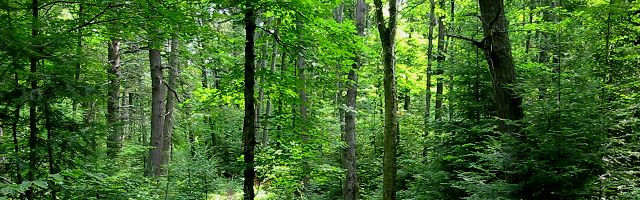 The western uplands are predominantly hardwoods and hemlocks (above) The eastern lowlands have widespread white and red pine, poplar and white birch (below) 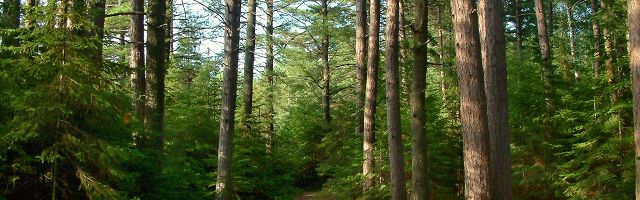 These distinctive forest types have developed over thousands of years, as a result of the combined effects of the areas' different patterns of soil, drainage and weather. Even with the passing disturbances of fires, blights and logging .. these distinctions remain in the current forest of Algonquin Park. Natural Heritage The process of conserving the Recreational/Utilization zone's natural heritage can initially be difficult to grasp. The majority of us recreational users spend most of our time living in an urban environment. However, its from this very urban environment that the process of conserving "built heritage" provides something of a parallel to the conservation process being applied to the forest within Algonquin Park's Recreational/Utilization Zone .. to the extent that it applies to the concerns of recreational users in the immediate course of their camping trips. Urban Heritage Conservation Districts are developed through a specific process. First, a neighbourhood's desirable "built heritage" characteristics are identified. Next, a process is developed to keep and enhance those heritage characteristics. Finally, the continued compliance with the process's bylaws and the oversight-committee's controls preserve the heritage characteristics of the district's "streetscapes". These "streetscapes" include all the substantive elements visible from the public access or "street". They include lawns, fronts and sides of buildings, rooflines and sideyard structures. The area within the urban public's view from the street determines the extent to which this process can extend. However, rear walls, backyard structures and interior finishings are deemed fully within the realm of private property. As such, they are not subject to the controls of a Heritage Conservation District Committee. Rather, these elements are subject to regulation by municipalities' Building and Property Standards .. those which typically affect private properties. Conservation of the Recreational/Utilization Zone's natural heritage is achieved in a somewhat parallel fashion. Rather than as "streetscapes", recreational users' immediate concern is that of "landscapes" .. including all their substantive elements visible from the users' canoe routes, portages and hiking trails. However, at this point, a crucial difference comes into play. The park's entire area is public property. As such, the conservation of all of its natural heritage characteristics is a matter of concern to all interest groups .. naturalists, environmentalists, archaeologists, aboriginal bands, anglers, hunters, researchers, outfitters, industries and municipalities, as well as recreational users. Without the limiting distinctions associated with private land ownership, the park's Recreational/Utilization Zone is subject to the government's administration and control (on behalf of the public, which it represents). It is this administration and control process that has brought the Algonquin Park Management Plan and the AFA into existence. In turn, it is the AFA's desire to be competitive and successful that has driven it to seek Forest Certification and CSA Registration .. built in turn on continuation of the public advisory process. |
