
 Algonquin Park Forestry - AFA Advisory Group For CSA Certification
Algonquin Park Forestry - AFA Advisory Group For CSA Certification
Algonquin Park Forestry - AFA Advisory Group For CSA Certification
|
Notification was received from Gord Cumming, Chief Forester of the Algonquin Forestry Authority ... "We have completed the internal audit of the EMS/SFM System. The lead auditor, Craig Howard of BioForest Technologies Inc., completed this audit with the assistance of AFA's Compliance Coordinator (Ron Cahill) during the week of October 22nd. I know that some you were contacted by Craig during the audit. An audit report has been supplied which included one opportunity for improvement (OFI) and one non-conformance (NC) related to the CSA Z809 Standard. We have addressed these items, and are now looking forward to the registration audit which is scheduled for the week of December 10th." Martin Litchfield and Bruce Ferguson will be conducting the CSA registration/EMS re-registration audit on behalf of Quality Management Institute (QMI). Some of you will also be contacted by Martin or Bruce during the week of the 10th, or sooner. The AFA website has been updated to include the latest information on CSA certification for the Algonquin Park Forest. This update includes posting the SFM Plan and associated appendices. I encourage you to check out the site at http://www.algonquinforestry.on.ca/ and look at the "Forest Certification" page for details. The AFA Sustainable Forest Management Plan (Nov. 2007 - for CSA Certification) is a 102 page PDF document that can be downloaded through the AFA website .. or directly from it here. September 22nd, 2007 ... eighth meeting update The September 14th advisory meeting involved a review of some refinements by the AFA to the VOIT document which was originally finished in May. In the course of discussions about maintaining wildlife species habitat, concerns were generated involving the MNR's (and thereby the AFA's) inclusion of a 20% lowering in the accepted levels within the definition of the Bounds of Natural Variation. In the matter of John Winters having wanted to revamp the park complaint process, the AFA had added a target date (Dec., 2008), an AFA designate and the process being subordinate to the AFA. In addition, the County of Renfrew member wanted any revisions to the complaint process to be cleared by the AFA advisory group. I objected that it was a park process and only incidental to the CSA process. The AFA conceded they'll confer with John on the issue. (*) After lunch, the Draft Sustainable Forest Management Plan was distributed. The advisory group's comments and concerns will be received up to Sept. 28th. The final SFM Plan will be available on the AFA website. (*) Months ago, John Winters had referred to the need for the park's entire complaint process to be revamped under his direction. Over the course of the summer, the AFA and the County of Renfrew have tried to limit and to influence the process, by means of their modification of the VOIT describing the complaint process. Just days ago, John Winters indicated to me that the complaints process will not be handed over to the AFA. He has clarified that as managers of the Park, it's the MNR's role to ensure that all complaints are addressed according to Ontario Government requirements. Update: seventh meeting of May 25, 2007 The meeting picked-up where the VOIT's review left off at the beginning of the month. While there was some trouble dealing with Non Forestry Benefits' objective and indicators, the VOITs concerning Aboriginal and Treaty Rights, aboriginal consultation plus involvement in management activities were successfully refined. Public participation, education, partnership funding and research, plus advertising to promote certification, were detailed in other VOIT's. Eco-Watch expressed some technical concerns relating to Red Spruce, Hemlock and aggregate extraction. We were informed that a draft SFM Plan would be developed over the summer and brought to the group's September meeting for review. We were also told that information would be sent out ahead of time, to enable members to review it prior to the September. 11th meeting. May 6, 2007 ... update of the sixth meeting Prior to regular business at the April 23rd and 24th meeting, AFA staff (without the KBM facilitors present) requested that each of the group express their opinions concerning input, participation and expectations experienced through the advisory process to date. I happened to be sitting at one end of the "U-shaped" tables and was asked to start with my opinion. It happened that I had a print-out of the critical observations I'd expressed "Further To The March Meeting" (scroll down). It occurred to me that, not only was this an ideal time to share my concerns directly with the AFA and the advisory group collectively, it also addressed the very issues being inquired of. I prefaced my word-for-word reading of the article by explaining that it appears on the Algonquin Adventures website as part of my reporting to its readers. It was well received by a number of the group. The Algonquin Eco Watch representative was the next to speak. I'm quite thankful to him for basicly acknowledging my observations and for recognizing the need for refocussing our collective attentions to the certification process of the current FMP. The entire session proved valuable as an opportunity to openly share our individual opinions on the advisory process to date. Returning to regular business, we resumed with the Recreation and Tourism values' objectives to maintain or improve the back-country qualities of recreation and tourism opportunities within the Designated Forest Area, through the reduction of sight and sound evidence of AFA operations. A few days prior to the meeting, an updated 2007 work schedule map, showing all primary and secondary logging roads, had already appeared on the AFA website. The AFA position at the meeting was that such a portrayal held too much information and would overwhelm those trying to make summer trip plans. Once it was realized that this very same portrayal had already been posted on the AFA website, it was taken off-line by day-two of the meeting. An alternative was discussed and agreed upon .. one showing public roads and summer haulage routes, along with seasonal work areas. (NB: This revised map has subsequently placed on the AFA website) The balance of the meeting progressed at a good rate through the Timber and Non-Timber Benefits values .. as well as those of Communities and Sustainability, and of Fair Distribution of Benefits and Costs. At the end of the meeting's designated time-period, we were asked if we were prepared to take a break and then continue with the balance of the values. Given that the outstanding values were those of Accepting Society's Responsibility for Sustainable Development, which included Aboriginal values, the members insisted that more time than a "tail-end" two hours was needed to do justice to them. As a result, an extra one-day meeting has been scheduled for late May. April 9, 2007 ... further to the fifth meeting The March 22nd and 23rd advisory meeting made it clearer than ever to me that the AFA is firm in its position that its current 2005-2025 Forest Management Plan is the foundation of its registration to the CSA Sustainable Forest Management Standard. That FMP was started in 2002 and was predicated on the official policies in effect at that time. It also became quite clear to me that Algonquin Eco Watch representatives are determined to bring elements of the 2003 Old Growth Policy for Ontario's Crown Forests, the 2004 Forest Management Planning Manual for Ontario's Crown Forests and their own progressive forestry positions into the V.O.I.T. matrix which will be intregal to the certification of the AFA's 2005-2025 Forest Management Plan. At the same time, the AFA insists that new 2003 and 2004 provincial policies, their supportive science and any associated practices should only be involved in the upcoming 2010-2030 Forest Management Plan and its subsequent CSA certification. I originally became aware of this "time-lag" between policies, plans and practices when I prepared the Timelines page. The sequence of events, from the international, national, Ontario MNR and Algonquin Park levels to that of the AFA and CSA, are clearly subject to a "time-lag" into the future. Each side gives the appearance of being entrenched in an "all-or-nothing" position relating to policies, procedures and practices. At the outset, the situation had not been helped by the AFA's facilitators' original method of consensus-building, their highly detailed draft "seed-documents" and the AFA's original representation of shelterwoods' last-density 120 year old trees as equivalent to "old growth forest". Subsequently, Algonquin Eco Watch was perceived to be basing their positions' legitimacy on that of the new 2003 Old Growth Policy and the 2004 Forest Management Planning Manual, which the AFA tended to discount from having relevance for the current FMP. While I found myself opposing the AFA's position on "old growth" due to what I fealt was blatant misrepresentation, I found myself opposing the Eco Watch position for restoration of red spruce and hemlock to pre-industrial levels based on what I believed was questionable information. Despite my optimism on recreational-user issues, I left the March meeting feeling that Eco Watch and the AFA were not getting any closer together. Early in April, my feelings were confirmed with the receipt of a detailed group-wide email from Eco Watch describing serious concerns at a number of levels. I'm not detailing their concerns here, as I consider them as internal to the advisory group's workings. However, the concerns are being taken seriously by the AFA because within a couple of days I was telephoned (as were other group members) by the AFA asking my position on Eco Watch's emailed concerns. In response, I expressed that respective positions had to be better explained and appreciated by all parties. I also said that clarifications had to be made about the "time-lag" between policies and practices .. that they had to be openly mentioned in the advisory report's documentation. I explained that unless such a full description of both the present and future processes was added to the advisory report, the current distrust and counter-productive divergencies would do serious harm not only to this certification process but could also negatively impact on advisory participation in the upcoming renewal of the Forest Management Plan for 2010-2030. March 27th, 2007 ... fifth meeting update The fifth advisory group meeting occurred March 22nd and 23rd, outside of Huntsville. A special presentation by Algonquin Eco Watch preceeded the regular meeting. Eco Watch had Arborvitae Environmental Services Ltd. previously prepare "Management of Old Growth Pine and Provision of Associated Habitat in Algonquin Park" in printed report form and then present it before the group in audio-visual mode. The purpose of this presentation was for Algonquin Eco Watch to provide a depth of background information in support of their positions on several sensitive ecological issues. I took the opportunity to raise the question of establishing "candidate areas" for pre-maturity-old-growth .. as eventual replacement for those old-growth areas that succum to post-climax degradation. The resulting discussion made it quite clear that trying to pass-off the last stages of old shelterwood as "renewed old-growth" was a not a valid alternative. I made it quite clear that I was advocating a comprehensive and long-scale management of genuine old-growth forest. Clarification was provided by Gord Cumming, that the new "Old Growth Forest Definitions For Ontario" will be incorporated into the upcoming 2010 Algonquin Forest Management Plan. However, he said that in the meantime, the pre-old-growth approach should apply to this CSA certification process. A fine split-in-time appears to place a different status on old-growth concepts. Before 2008, they are only officially recognized principles. At some point thereafter, it is anticipated these concepts will become built into official procedures, rules and regulations. Thus, the "old-growth" controversy presently continues. 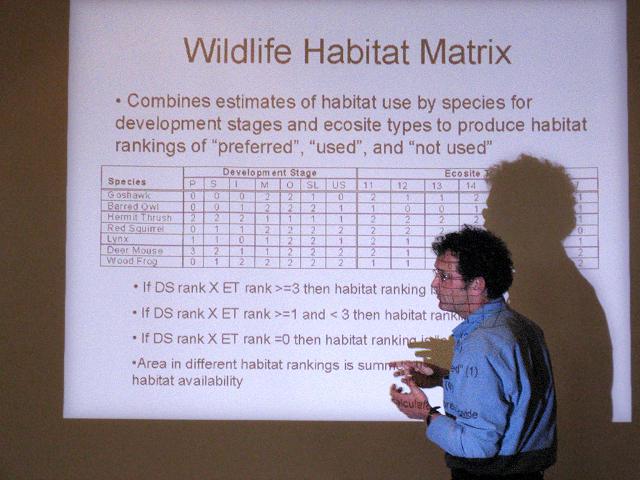 "Chris" (one of EAS staff) presenting information on wildlife habitats.
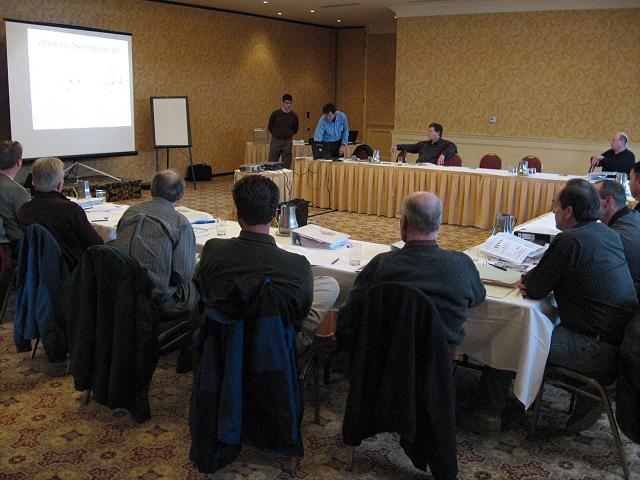 The majority of the advisory group members came early for the Eco Watch pre-meeting presentation.
Gord Cumming (AFA) also presented some background information prior to the regularly scheduled meeting. He provided insight into the "Standard Operating Procedures" used in the field by all AFA operators. He provided the example of the highly detailed, step-by-step procedures (11 pages) that have to be adhered to for installing portable bridges over watercourses. The purpose of this presentation was clearly to re-assure us that the AFA's conservation efforts are extensive. The previous meeting's "values" and "objectives" had been consolidated with the first meeting's "seed" information and then re-distributed by email-attachment prior to this meeting. The focus of this meeting was to refine the accumulated "Voit Matrix", including the elements' "Indicators" and "Targets". In the area of red and white pine, distinctions were established between "old-trees" and "old-growth-forest" .. preventing the remaining "old-trees" of thinned-out "old-shelterwood-stands" from being considered equivalent to "old-growth-forest" (1.1.1.2). In the areas of Species and Genetic Diversity, some opinions outside the general concensus were ofiicially placed on the record. Serious concerns were expressed and a lot of time was spent by Eco Watch over the issues of restoration of red spruce and hemlock to pre-industrial levels. While I had agreed over the "old-growth" issues, I couldn't share similar convictions over large restorations of red spruce and hemlock. A tightening-up of the portion of productive forest that can be used for roads, landings and aggregate pits was achieved. When it came to "Recreation and Tourism" (5.1.2.1.2) , I presented my first proposal ... Objective: To maintain or improve the wilderness-like qualities of recreation and tourism opportunities within the DFA (designated forest area), through the reduction of sight and sound evidence of AFA operations. Indicator: Number of documented public complaints about forestry impacts on recreation. Target: 95% of documented public responses to redesigned feedback program (from interior users within the RU zone) without noted logging impacts. This initial proposal successfully achieved consensus of opinion. I then presented my second "Recreation and Tourism" proposal ... Objective: To increase wilderness-like opportunities for recreational users by informing them of where sight and sound evidence of AFA operations is to be avoided. Indicator: Number of documented public complaints about forestry impacts on recreation. Target: Improve users’ ability to plan recreational trips away from sight and sound of AFA operations and thereby improve public feedback response rate. While I was pushing for inclusion of the log-hauling roads on the annual Harvest Schedule Map, there were some concerns that logging roads shouldn't be shown. I repeated my original position, that primary and secondary logging roads were already available on another public AFA map .. and that highly detailed imagery exists on "Google Earth". Carl Corbett said he would bring a revised Harvest Schedule Map to the next meeting, with primary logging roads and exit-points shown ... as a point for discussion and perhaps a consensus-building example for the annual Harvest Schedule Map. It was at this point that the meeting ran out of time and ended. February 15, 2007 ... fourth meeting update The 4th AFA CSA Certification Advisory Group meeting had an early start. Advisory group members, AFA staff and KBM facilitators met at the Madawaska Processing Yard at 10 am Feb. 12th. After being orientated to a detailed map of the area we would be inspecting, we headed north in a convoy of AFA vehicles. 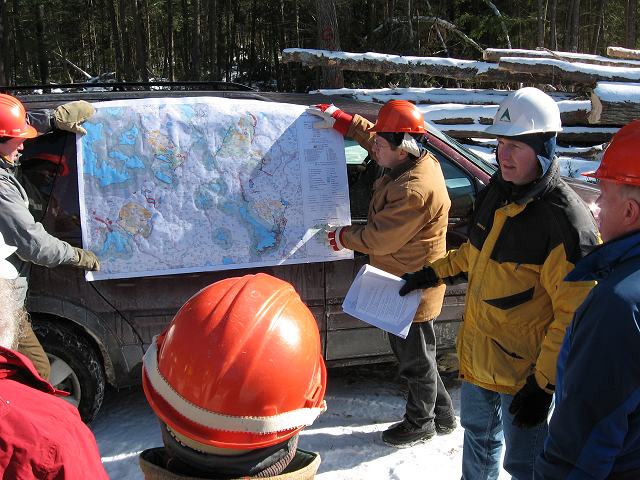 Overview being given by Gord Cumming, AFA Chief Forester, at the Madawaska Processing Yard.
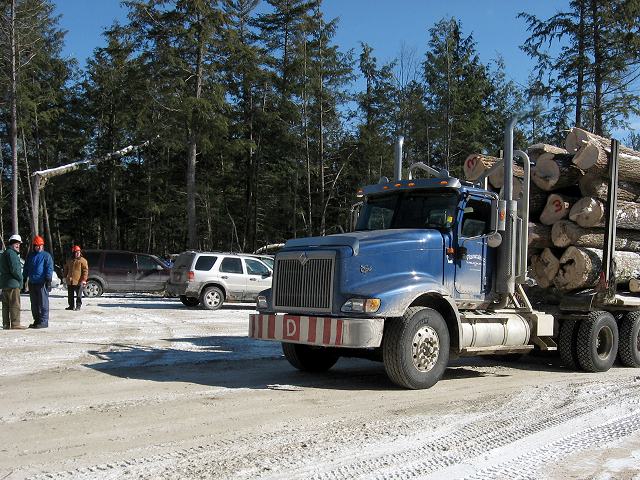 Approx. 1 1/2 hours later by logging road, we were SE of Dickson Lake at our first instruction site and lunch stop.
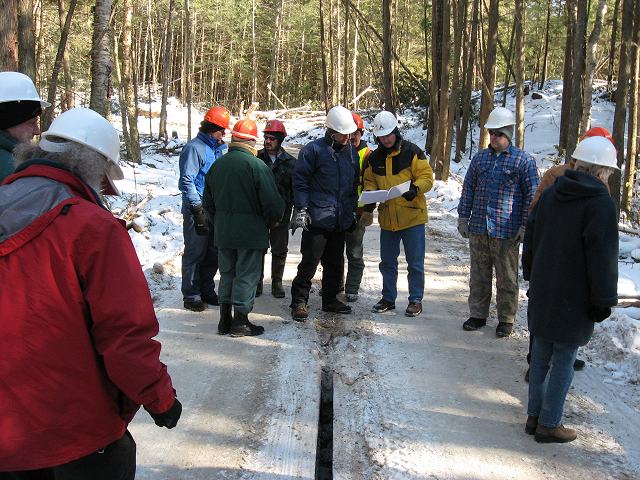 Inspecting a steel portable bridge laid over a watercourse .. on a "winter" logging road.
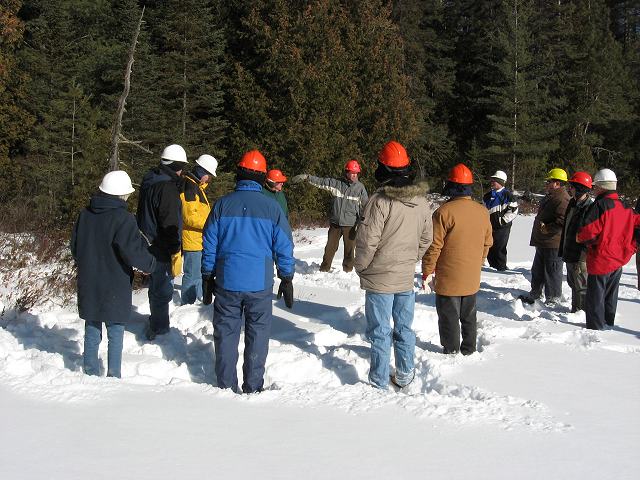 Another instruction .. on the ice of a small lake .. discussing shoreline set-back reserves.
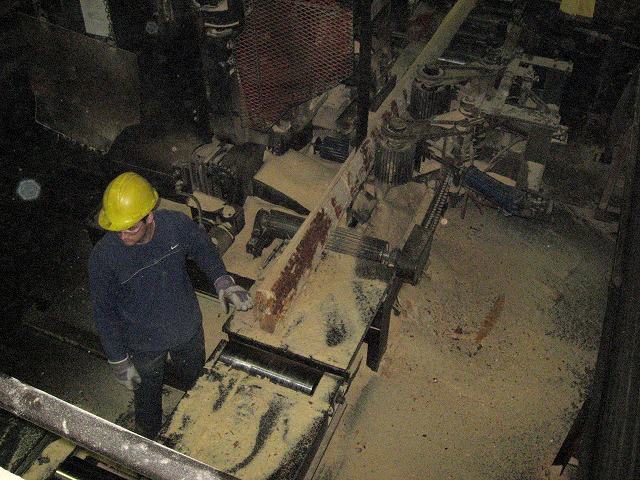 After a couple more in-park instructions, by 3:30 pm we were touring part of the Murray Brothers Mill.
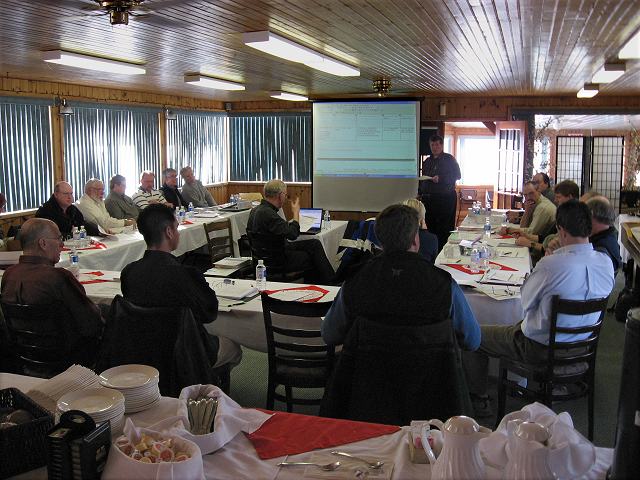 At Spectacle Lake Lodge, advisory sessions ran: Monday 7 to 9 pm, Tuesday 8:30 to Noon and 1 to 3:30 pm.
Under Dave Thomson and Herb Bax, we refined the "values" and "objectives" determined at the previous meeting. They were consolidated with the earlier meetings pre-drafted "seed" information by way of a projected computer spreadsheet. When I raised my concern over the areas of summer log-haulage noise not being indicated on the AFA's yearly work schedule maps, there was considerable resistance to having any larger areas of negative impact portrayed on their map. The AFA and some loggers feel that this would be pre-notifying an unproven negative impact, for which there was no measureable, quantified documentation. Their arguement was that work schedule maps portraying additional lengthly "noise corridors", tagged with cautions that "haulage truck noise may be encounted during day hours in these areas", would present an inaccurate impression that logging operations were involving far more than the actual cutting and work areas of 1 to 2% of the park at any one time. Additional concern was expressed that there were no supportive "measurements taken" or "detailed complaints" on record. The balance of values are well documented and measured, with standards and disciplines already well established. The issue of truck noise was obviously a tenuous and prickly one. It was at this point that John Winters (Superintendent of Algonquin Park) indicated that he was prepared to review the official complaint system and upgrade it to match other large park juristictions. A more detailed and responsive complaint system would be better able to identify and quantify any such concerns as logging truck noise. He asked that myself and the Friends of Algonquin serve in an advisory capacity in the revision of the complaint process. At a break in the meeting, we conferred further. John indicated he would have his staff research the complaint process in other provincial and national parks. He then wants a face-to-face advisory meeting for input and review of any options involved. It is his hope to have impovements to the complaint process in place for this summer season. I consider this quite a sensitive and generous response, on John's part, to the issue at hand. At such time as logging truck noise complaints can be officially documented, detailed and quantified .. a more responsive position will obviously be expected from the AFA. Future reviews of the CSA certification process would incorporate such changes. January 14, 2007 ... third meeting update The 3rd AFA CSA Certification Advisory Group meeting (Jan. 8 & 9th) went well! The KBM Forestry Consultants' facilitators had taken a step back and decided to change their methodology. As a result, quite a bit of progress was made in laying down "values" and "objectives". Dave Thomson was KBM's primary facilitator, elicitting input and commentary from group members. He effectively promoted discussion of many issues, causing a number of different perspectives to be openly shared. Under Dave's direction, Herb Bax operated an on-screen "Powerpoint" recording of the group's input. As a modern version of the traditional "flip-chart", this process provided an efficient way of compiling, organizing, refining and revisiting the accumulated "values" and "objectives". This Powerpoint file will serve as the base for the February meeting at which we'll be getting into associated "targets" and "indicators". PDF versions of the file will be emailed out to group members along with minutes of the meeting. I handed out over two dozen copies of readers' forum and email-submitted "values" input. The commentaries were well-received and became part of the official record. I remain optimistic that in the interest of recreation users, we'll be able to achieve some increase in trip-planning details (active haulage noise zones) from the AFA and an earlier annual release of that info.
On December 5th, a revision of the Forest Certification Advisory Group Terms of Reference (based on input from the November meeting) was emailed out to advisory group members. Its section pertaining to Decision Making Methods included substantial modifications and clarifications .. both in the areas of consensus building and dealing with dissenting opinions. On December 20th another email was sent out from the AFA to all advisory group members. In it, Gord Cumming stated ... "We are pleased to inform you that we’ve made a few changes to the agenda and format of the next meeting. At the next meeting we will be finalizing the terms of reference which establishes the consensus based approach, and following this format for all future meetings. Dave Thomson will also give us a presentation on participatory decision making and he will facilitate all future meetings. Our last meeting was intended to allow the Advisory Group to review the proposed VOITs for the first two criteria, to better understand the process and provide an opportunity for discussion. In retrospect, we delivered a great deal of detail and likely limited discussion for the group as a whole. The good news is that we can now move forward with a clear understanding of what a VOIT should look like at the end. The agenda for the January meeting will focus on a discussion to identify values for the Algonquin Park Forest. To that end, we are asking each of you to consider the question “What does Algonquin Park mean to me?” The responses to this question and subsequent group discussions should help us identify values on the forest and formulate objectives for these values. This information will be used to draft and review individual VOITs at subsequent meetings." The email's attached agenda for the January meeting includes a presentation titled "Introduction to Participatory Decision Making", the previously mentioned revised "Terms of Reference", a discussion of "What does Algonquin Park mean to you and what values are important to you and/or the group you represent?" .. and then defining these values' objectives, indicators and targets (V.O.I.T.'s). It appears that the AFA and its consultants intend to redirect the advisory process .. in a more open and participatory direction. This redirection appears to be responsive to concerns expressed by a number of the advisory group, myself included. I'm optimistic that subsequent meetings will be less "top-driven" and more "member-participated". As I have already requested on this website's forum, please email me with your own response to "What does Algonquin Park mean to you and what values are important to you as a recreational user?". I'll be presenting representative responses to the advisory group at the next meeting.
In this new "Forestry" section of the website, I'm providing typical recreational users of the park with insight into the practices, regulations and controls involved in Algonquin Park forestry and logging. Also, I'll be describing any concerns I may have about individual issues and the general process itself. I've come away from the second meeting (Nov. 20 -21) with two areas of concern which haven't been resolved. My first area of concern involves the procedural issues of how the group's "consensus of opinion" will be measured or reached, and how any "dissenting opinions" will be recorded and presented in the public record. My second area of concern involves the issues of "Defined Forest Area" and "Old Growth Forest". In the weeks to come, I'll be detailing these concerns within the "Forestry" section. I hope to search out others' opinions in these areas and to provide a broadened understanding of the issues.
With municipal election-clerk duties tapered-off, I'm now able to read through reference materials received at the first meeting and since emailed-out to group members on November 6th and 10th. At the first meeting, we'd received the updated Z809-02 Sustainable Forest Management: Requirements and Guidance (National Standard of Canada), which is available online from the CSA at www.csa.ca/%5Crepository%5Cgroup%5CZ809-02july.pdf. This 78 page document lays out the necessary compliancy mechanisms in order to achieve CSA registration and certification. In addition, we'd received a copy of the advisory group's operational "terms of reference". The Nov. 6th email included minutes of the first meeting, along with PDF versions of two Powerpoint presentations given at that meeting. The main item in the Nov. 10th email was an extensive internal document presenting draft "VOITs" (Values, Objectives, Indicators and Targets) of the AFA's operation .. key compliancy components in the Forest Certification and CSA Registration process. These components are the primary focus of the advisory group's upcoming review and recommendation functions. The email also included an additional copy of the advisory group's "terms of reference" and the upcoming meeting's agenda. The preliminary meeting will overview the Defined Forest Area (DFA) and the VOIT system. The meeting's main session will include presentation, discussion and finalization of VOITs pertaining to biological diversity, plus ecosystem condition and productivity.
Well, it was an evening, morning and early afternoon of pretty intensive info! I rolled back into town just before dinner today, with a binder full of printouts and a head almost choked with info overload. I always figured the AFA forest management process was complexed. However, participants in the certification process are expected not only to grasp the logging processes involved, but at the same time to come to grips with the intricasies of the certification process and to also develop an appreciation of each-others experiences and perspectives .. all necessary steps in the development of concensus of opinions. Like I said, I'm "back to school" with this commitment. There are a half dozen more meetings scheduled through to early spring .. along with follow-up meetings every six months over the next two and a half years. There are 20 people in the advisory group representing archaeology, local bands, anglers/hunters, the local public, AFA directors, Ontario Parks, research, outfitters, forest industries, local municipalities, environmentalists and recreational users. 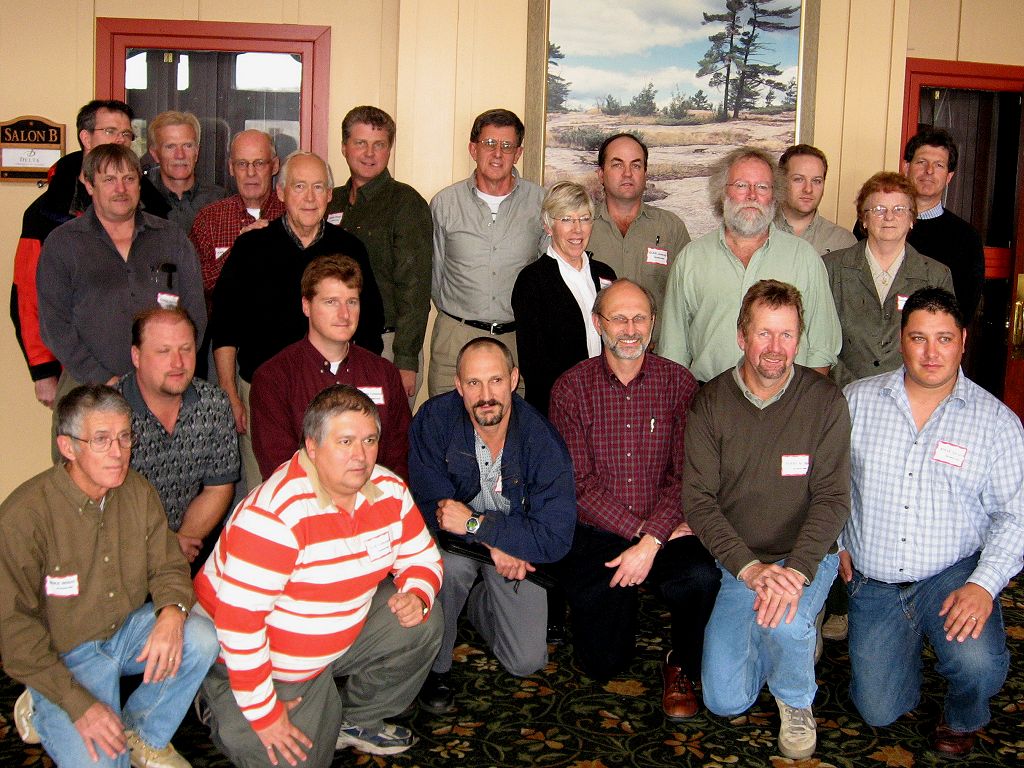 Majority of those in attendance (click on photo to download larger version). On a personal note, I work for my local town government and am in the thick of municipal election preparations. So, until the elections (Nov. 13th) are over, I won't be able to give all the time I'd like to, to dealing with this topic on AA. However, I expect to find sufficient time during the week between Nov. 13th and the next AFA-CSA meeting, to get a proper grasp of the info, to share some of the issues with "you-the-readers" and to generate some feedback from you. In addition, at some point, the AFA itself will be placing some info and documentation relevant to the CSA certification process on their own website.
I've recently accepted an invitation to serve on the forest certification advisory group for the Algonquin Forestry Authority's application for CSA certification. Since some of this website's readers may not realize that the park's history is deeply involved with logging or may not be aware of how logging still goes on within the park, I've added this new subsection the to website in order to provide insight to the status of logging in Algonquin Park and its relationship to the park's recreational uses. I've always been interested in the means by which the MNR manages the park and the AFA manages its operations. Over many years, I've attended open houses and communicated with both organizations' senior staff. However, this is my first opportunity to serve in an official advisory capacity. While it is my position that limited and properly managed logging has a valid place in the life of Algonquin, I also believe that there should be responsible and continually improved care of our natural heritage. Within the framework of forest management, I encourage readers to submit their informed observations and constructive comments (forest@algonquinadventures.com). In this new "Forestry" section of the website, I'll be providing readers with background and resource information, a sampling of any feedback, plus progress reports of my involvement in the advisory process. The section's own ledt-side menu will navigate one through the section's content. |
|
|
 November 6th, 2007 ... AFA Sustainable Forest Management Plan - November 2007